
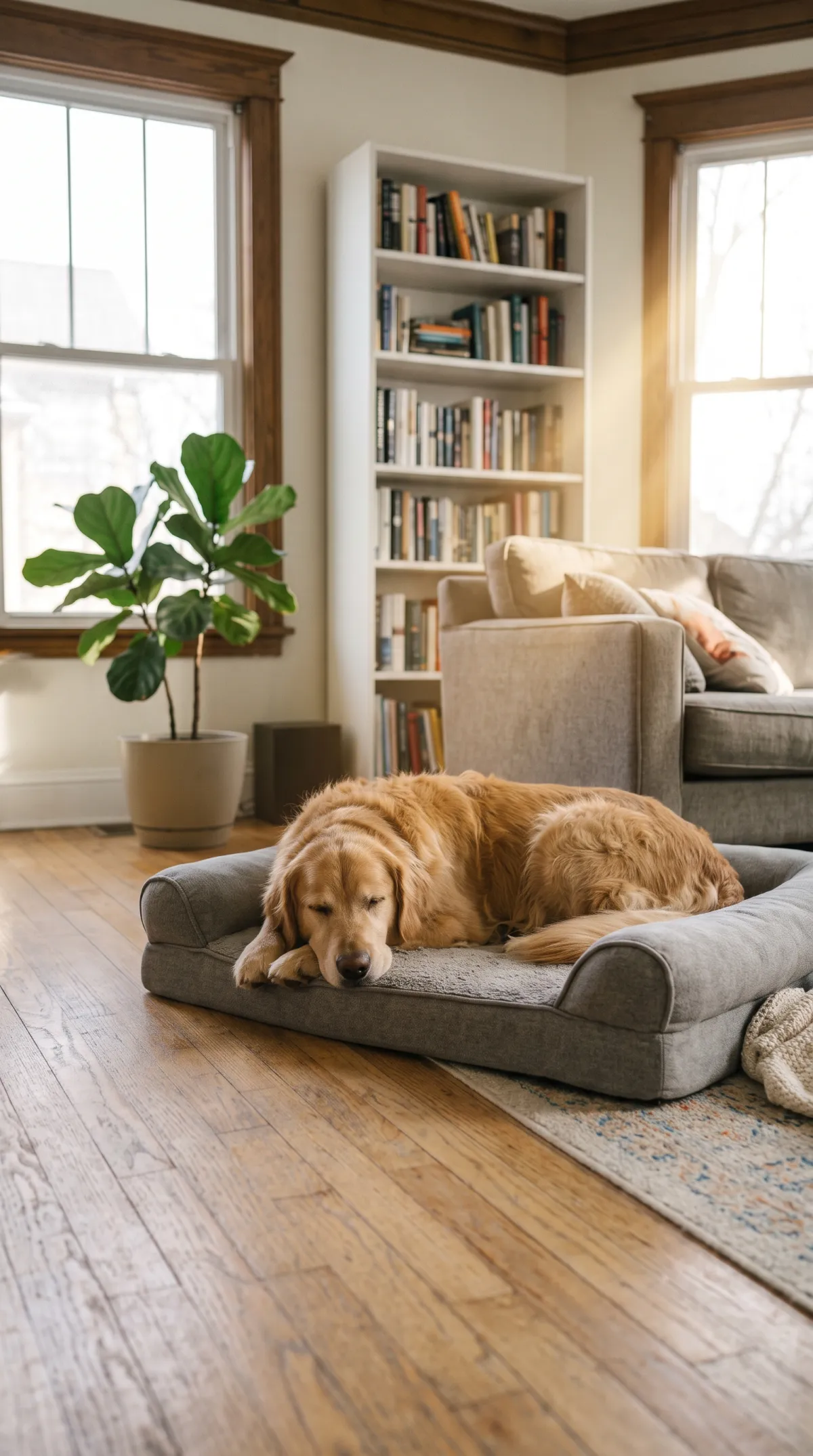
How to Teach Your Dog to Settle During Family Meals
Dinnertime is one of the most predictable daily training opportunities most households never intentionally use. The family sits down, the food comes out, and the dog begins its routine: hovering at the table, nudging elbows, staring with the intensity of someone who hasn’t eaten in a week despite having eaten an hour ago. Most owners respond by telling the dog to go away, giving it something to do it ignores, or eventually giving in and feeding it something from the table.
Each of those responses, including the correction, teaches the dog something about how this situation works. Usually the wrong thing. Building a genuine mealtime settle requires understanding what’s actually being trained, setting the environment up correctly, and being more consistent than the dog is persistent.
Why Mealtime Is a High-Arousal Training Context
Food being prepared and eaten produces a predictable arousal response in most dogs. The smells are compelling, the family is gathered and stationary which makes proximity rewarding in its own right, and the entire setup has probably already taught the dog that sustained presence near the table eventually produces results.
Fun Fact: A dog that has been fed even occasionally from the table during meals has received what behaviorists call a variable reinforcement schedule for hovering behavior, which is the most powerful schedule for maintaining a behavior, because the dog has learned that the behavior sometimes works, which is enough to keep it going indefinitely even if it stops working entirely for weeks at a time.
The challenge at mealtime isn’t that the dog is uniquely stubborn or food-obsessed. It’s that the behavior has a reinforcement history that makes it resistant to extinction, and the arousal the food context creates makes it harder for the dog to access the calm, trained behaviors it knows in lower-arousal situations.
Preparation: The Work That Happens Before Dinner
The most effective mealtime training happens before anyone sits down. A dog that arrives at the dinner table already at an elevated arousal level is a harder training scenario than one that arrives having already been given a structured outlet and a clear expectation.
A short training session, a walk, or any structured engagement ten to fifteen minutes before dinner addresses the arousal level the dog brings to the meal. A dog that has just done some mental or physical work is lower arousal and more likely to hold a calm behavior throughout the meal than one that has been lying around waiting for the interesting thing to happen.
Equally important is deciding in advance where the dog is expected to be during the meal. A specific spot, a mat, a bed in a defined location, gives the dog a concrete place to go rather than a vague expectation to not be at the table. The specific location matters less than its consistency: the same spot every meal creates the habit faster than rotating between options.
Establishing the Boundary Without Starting a War
The early stages of mealtime training are more management than training in the traditional sense. The goal isn’t to win a confrontation at the table. It’s to create the conditions where the dog makes the right choice enough times that the right choice becomes the default.
Quick Fact: A leash tether or baby gate during the early stages of mealtime training is not a punishment and not a permanent solution. It’s a management tool that prevents the dog from rehearsing the hovering and begging behavior while the alternative is being built, which is important because every repetition of the undesired behavior during training reinforces it.
Directing the dog to its spot before sitting down, and reinforcing for being there at the start of the meal, begins the association between mealtime and the spot. The dog learns that dinner starting predicts that going to its spot is the right move, rather than dinner starting predicting that approaching the table is the right move.
Reinforcing Calm Without Teaching Another Kind of Hovering
The most common mistake in mealtime training is reinforcing the dog for being on its spot by going to it every few minutes during dinner. The dog learns to be on its spot and wait to be rewarded rather than to genuinely settle, and the constant attention from the handler actually prevents the dog from downshifting its arousal and resting.
Reinforcement for mealtime settling works best when it’s intermittent and comes during moments of genuine calm, not on a predictable schedule. A dog that receives occasional, calm reinforcement for remaining on its spot throughout the meal, with reinforcement becoming progressively less frequent as the behavior becomes more established, learns to hold the behavior without monitoring for the next reward cycle.
Reinforcement Approach | What the Dog Learns | Long-Term Result |
|---|---|---|
Reward every minute on a fixed schedule | To wait and watch for the next reward | Vigilant behavior, not genuine calm |
Go to dog whenever it breaks and redirect | Breaking produces attention | Increases breaking behavior |
Reward only genuine calm moments, decreasing frequency | That calm holding produces occasional reward | Genuine relaxation, durable behavior |
Never reinforce, only correct breaks | Ambiguity about what’s expected | Anxiety, inconsistent compliance |
The third approach in that table is what produces genuine settling rather than a dog that’s technically on its spot but is still alert and waiting. Calm verbal praise or a low-key food reward delivered without excitement during genuine rest moments shapes the emotional state, not just the position.
How to Avoid Accidentally Rewarding Begging
Every time a dog that’s begging receives anything, including attention, eye contact, a correction, or food, the begging behavior is being responded to. Dogs don’t distinguish between positive and negative responses to their behavior the way humans assume. Any response that follows a behavior can reinforce it if the dog finds that response valuable.
Fast Fact: Many dogs who beg persistently have learned to ignore corrections in the mealtime context because the corrections have been inconsistently applied and because the occasional success of begging behavior has outweighed the occasional correction in the dog’s overall experience of what works at the dinner table.
The most effective response to begging that has already started is to redirect to the spot without drama, reinforce for going there, and then genuinely ignore any subsequent begging behavior that follows. Not punishing it, not giving it a frustrated verbal correction, but genuinely withholding all attention for as long as the begging continues.
Every person at the table needs to apply the same standard, because a begging dog that gets a response from one family member while being ignored by others learns that the behavior works when directed at the right person.
Progressing From Managed Meals to Genuine Calm
The progression in mealtime training follows the same general arc as any duration behavior: easier conditions first, more challenging conditions as the behavior becomes reliable.
Early meals involve shorter dinners, quicker reinforcement cycles, and higher management. As the dog demonstrates the ability to hold its spot through a full meal with familiar family members, variables that increase the challenge can be introduced: longer meals, guests at the table, more aromatic food, children whose behavior is less predictable than adults.
Each successful meal is a repetition that makes the next one more automatic. The goal isn’t a dog that holds its spot perfectly at every meal in perpetuity through constant enforcement. It’s a dog that has had enough repetitions of the right behavior that going to its spot and settling when dinner starts is what it does because it’s what dinner looks like.
When This Is Not a Routine Manners Problem
It’s worth drawing a clear line between routine mealtime manners and more serious behavior concerns. A dog that hovers, begs, or is generally pushy around food during family meals is describing a manners problem. A dog that growls, stiffens, or shows any aggressive behavior related to food or family members being near its food is describing something different.
Food-related guarding behavior, whether directed at food in the bowl, food on the table, or food in a person’s hand, is not a training scenario to work through with the dinner table exercises described above. It needs professional behavior assessment before any training approach is applied. If mealtime hovering comes with any of those signals, the right path is a professional evaluation rather than a self-directed training plan.
Build Reliable Mealtime Manners With Cornerstone K9
A dog that settles calmly through family meals is the result of consistent training applied to a genuinely challenging context. At Cornerstone K9, our private lessons work through household manners scenarios like mealtime with the same precision we bring to any structured behavior goal.
For dogs where food-related concerns go beyond routine manners, our behavior modification program provides the professional assessment that more complex cases require. Serving Raleigh, Cary, Apex, Fuquay-Varina, Garner, Sanford, Fayetteville, Southern Pines, and Aberdeen. Reach out today for a free consultation.


