
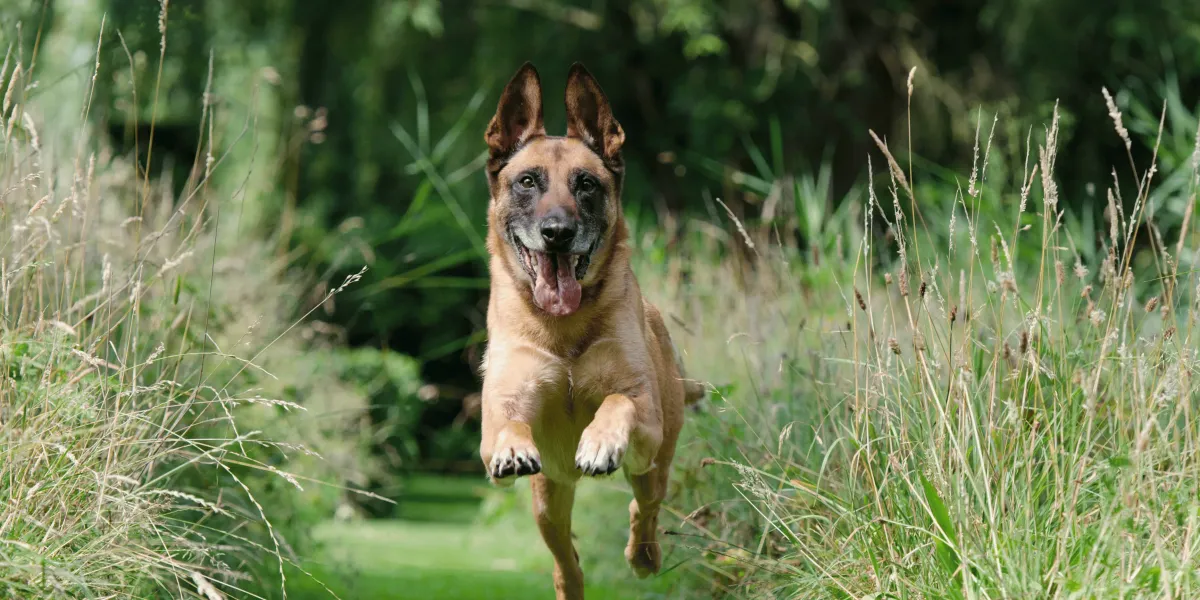
How to Teach Your Dog an Emergency Recall
There's a specific moment every dog owner fears: the gate opens unexpectedly, the leash snaps, the dog spots something across the road and commits before you can react. What happens in the next three seconds depends almost entirely on whether that dog has a recall trained to the level where it overrides everything else happening in the environment.
A basic recall and an emergency recall are not the same thing. A basic recall is a command a dog responds to reliably under normal conditions. An emergency recall is a command a dog responds to when conditions are anything but normal, when arousal is high, when the distraction is compelling, when the dog is already in motion away from you. Building one requires a specific approach that most recall training never actually reaches.
Why Most Recalls Aren't Emergency Recalls
Most dogs have some version of a recall. They'll come when called in the backyard, in a quiet park, when nothing more interesting is happening. That recall fails precisely when it matters most because it was trained to a level of reliability that everyday environments require, not the level that genuine emergencies demand.
Fun Fact: A recall that works ninety percent of the time is not a safe recall. That ten percent failure rate includes the exact moments when the dog is most aroused, most distracted, and most committed to moving away from the handler, which are also the moments when a recall failure is most likely to result in injury or worse.
The core difference between a reliable dog recall and an emergency recall is what the command has been conditioned to compete against. A standard recall competes against mild distractions. An emergency recall needs to compete against a running squirrel, an open road, another dog, a stranger with food, and any other maximally compelling thing the dog might encounter. Those require completely different training histories.
The Emergency Recall Needs Its Own Cue
This is the most important structural decision in emergency recall training, and it's the one most owners skip. The emergency recall should use a different word or sound from the everyday recall. They are different commands with different training histories and different levels of reliability, and they need different cues to stay that way.
Quick Fact: Using the same recall cue for both everyday recalls and emergency recalls means that every time the everyday recall is given and the dog responds slowly, wanders back, or ignores it entirely, the dog's response history to that cue weakens slightly, and an emergency recall needs a cue that has never been poisoned by being used in situations where the dog didn't respond.
Common choices for emergency recall cues include a specific word that isn't used in any other context, a whistle pattern, or even a distinctive sound. What matters is that the cue is reserved exclusively for emergency recall practice and never used casually. Its rarity is part of what makes it powerful.
Building the Reinforcement History First
An emergency recall works because the dog has been conditioned to associate that specific cue with the most extraordinary outcome it ever receives. The training process starts with establishing that association before any distraction is introduced.
Every repetition of the emergency recall cue during the training phase should be followed by the highest-value reward the dog will ever receive in a training context. Real meat, cheese, a jackpot of the dog's absolute favorite food, delivered immediately and enthusiastically. The goal is to make that cue mean one thing and only one thing in the dog's experience: something exceptional is about to happen, and getting to the handler is how to get it.
This phase happens in low-distraction environments at close distances. The distance, distraction level, and competing stimuli all come later. The foundation has to be built first.
Training Phase | Environment | Distance | Competing Distraction | Reward Level |
Foundation | Home, zero distraction | Close, 5 to 10 feet | None | Highest possible |
Early progression | Quiet outdoor area | Moderate, 20 to 30 feet | Minimal | Highest possible |
Distraction introduction | Varied locations | Variable | Mild to moderate | Highest possible |
High-distraction proofing | Real-world environments | Distance varies | Strong competing stimulus | Highest possible |
The reward level never drops. That's what makes an emergency recall different from standard training where rewards are systematically faded. The emergency recall stays on a high-value reinforcement schedule indefinitely because the goal is to maintain an exceptional conditioned response, not to wean the dog off rewards.
What "Emergency" Means in Practice
An emergency recall isn't just a recall given urgently. It's a recall given when the dog is already committed to something else. Training for that specific scenario means deliberately practicing the cue when the dog is engaged with something compelling, not just when the dog is idle and likely to respond.
Fast Fact: The most common mistake in emergency recall training is only practicing the cue when the dog is already paying attention to the handler, which means the recall has never actually been practiced against the competing stimulus it's supposed to override in a real emergency.
Deliberate practice against mild distraction happens in controlled environments where the dog can succeed. The handler waits for the dog to become engaged with something in the environment, grass sniffing, watching another dog at a distance, investigating a smell, then uses the emergency recall cue. The dog gets the jackpot reward when it comes. The dog learns that no matter what it's doing, the emergency recall cue produces the most compelling outcome available.
Proofing the Recall Off Leash
Off-leash safety is ultimately what an emergency recall exists to protect, which means at some point in the training process the recall has to be practiced without the leash as a management tool. That step only happens after the conditioned response is strong enough that the handler has high confidence in the dog's response in the current environment.
A long line, a 20 to 30 foot leash that allows the dog to move freely while the handler retains the ability to prevent failure, is the standard bridge between on-leash and fully off-leash recall work. The dog practices the recall on a long line across a range of environments and distraction levels until the response is reliably fast and reliable before off-leash practice begins.
This connects directly to the generalization work that underlies all reliable obedience. A recall practiced only in the backyard on a long line isn't ready for a parking lot or a trail. The recall needs to generalize across environments with the same progressive approach that any other behavior requires. For a deeper look at why that generalization step matters and how it works, why dogs struggle with generalizing training covers the mechanics behind why behaviors that seem solid in one context fall apart in another.
What Makes an Emergency Recall Fail
Understanding the specific failure modes of recall training helps avoid them during the building process.
Calling the dog and not following through when it doesn't respond is one of the most damaging patterns. Every time the recall cue is given and the dog doesn't respond, and the handler doesn't make the recall happen through management, the cue weakens. For the emergency recall specifically, using the cue in situations where the dog is unlikely to respond before the foundation is solid undermines the conditioned response before it's fully built.
Poisoning the recall by using it to call the dog for something it doesn't like, ending playtime, going in the crate, getting bathed, teaches the dog that the recall sometimes leads to bad outcomes. The recall should end with something positive every single time, particularly in the early stages of building the behavior.
Using the emergency recall cue casually, calling it in situations where any recall would work, dilutes the exceptional conditioned history that makes it reliable under genuine emergency conditions. The emergency recall cue should be used sparingly in practice and reserved for the specific purpose it was built for.
Build a Recall That Works When It Counts With Cornerstone K9
An emergency recall is one of the most valuable things a dog can know, and it takes more deliberate work than most owners realize to build one that actually holds up when the stakes are real. At Cornerstone K9, our private lessons build recall reliability progressively, including the off-leash proofing and distraction work that separates a functional emergency recall from one that only works in the backyard.
For dogs that need a more intensive foundation, our adult board and train program builds recall alongside the full structure and generalization work that makes off-leash safety a realistic goal. Serving Raleigh, Cary, Apex, Fuquay-Varina, Garner, Sanford, Fayetteville, Southern Pines, and Aberdeen. Reach out today for a free consultation


